What is a Hash Value?
The values returned by a hash function are called hash values. Hash codes, hash sums, checksums or simply hashes are synonyms. A hash function converts a large, possibly variable-sized amount of data into a small code, usually an alphanumeric string. Recommind uses the MD5 algorithm (Message-Digest algorithm 5) to compute hash values.
The hash value is only calculated
- for standalone documents
- for attachments or embeddings if they are split off as documents during data loading.
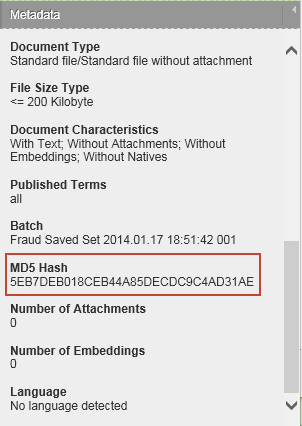
Hash values are shown
- In CORE Administration and Axcelerate Ingestion, on the Explore tab, in the Document View, in the MD5 Hash field.
- in Axcelerate 5, in the Metadata fly-in, in the MD5 Hash field.
Note: The hash value of emails is only displayed if they were standalone documents in the original data source, like MSG files, for example. For PST entries, the MD5 hash value is not shown in the Document View.
The hash value of a standalone document
Hash Value Computation Details
For a document that is not part of electronic communication, the hash value is computed from the native file with content and metadata that are contained in the original native file. It makes no difference whether the document is a standalone document or an attachment or embedding of another document or an email.
For electronic communication items, such as emails or chats, the hash value is computed from a customizable selection of fields.